Rizzio Casino Complaints and Reputation: What Current Records Show
 Available in GB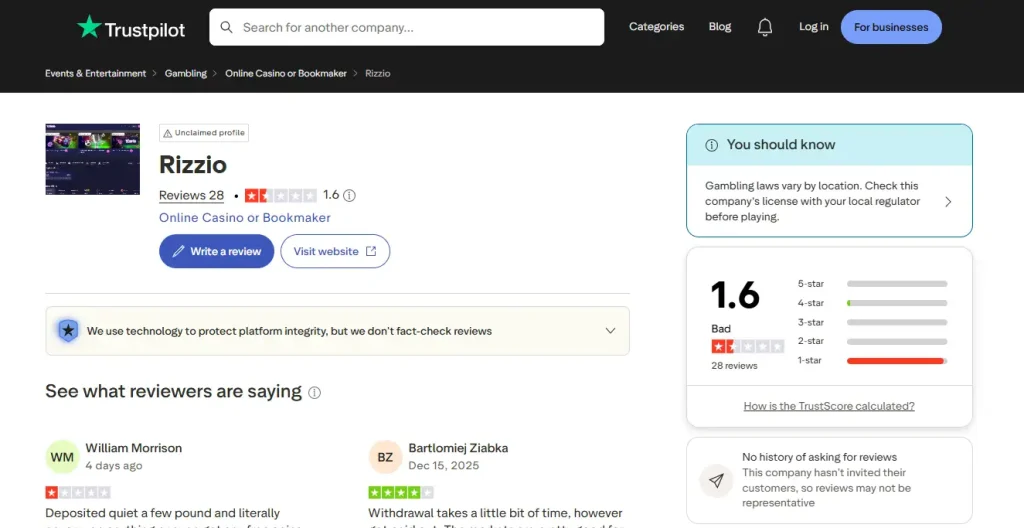
Table of Contents
- Rizzio's current reputation signals at a glance
- Trustpilot is strongly negative, but it remains user-submitted evidence
- AskGamblers adds complaint outcomes, not just ratings
- The recurring withdrawal theme deserves attention
- Verification complaints are not proof that KYC itself is improper
- Bonus and balance disputes need the same evidential discipline
- Casino Guru's 1.4/10 Safety Index uses a separate methodology
- Resolved complaints matter because cherry-picking gives a false picture
- What UK players can verify before depositing
- How much weight should you give one dramatic review?
- Use complaint records as a risk filter, not a verdict
- How much weight UK players should give Rizzio's complaint record
Section element
Current third-party records give Rizzio a weak reputation signal, but the sources need to be read carefully. Trustpilot currently shows a 1.6/5 TrustScore from 27 reviews. AskGamblers lists four casino complaints, with two marked resolved and two unresolved. Casino Guru currently gives Rizzio a 1.4/10 Safety Index, classified as Very low under its own methodology. Those numbers do not prove that every complaint allegation is true or that every player will have the same outcome. The recurring themes are still useful: public complaints repeatedly mention withdrawal delays, repeated verification requests and disputes over winnings or bonus terms. The most useful approach is to separate user allegations from documented complaint outcomes, and to weigh resolved cases alongside unresolved ones.
Section element
Rizzio’s current reputation signals at a glance
| Source | Current signal | What it can tell you | What it cannot prove |
|---|---|---|---|
| Trustpilot | 1.6/5 from 27 reviews | Shows the current direction of public reviewer sentiment on that profile. | Does not independently verify the truth of each reviewer allegation. |
| AskGamblers | 4 complaints; 2 resolved, 2 unresolved | Provides case-status information and shows that some disputes reached a documented resolution. | Does not establish that every allegation in a complaint is factually correct. |
| Casino Guru | Safety Index 1.4/10, Very low | Shows Casino Guru’s own risk assessment based on its review methodology. | Is not a regulator ruling and should not be treated as one. |
These sources point in the same broad direction: Rizzio has meaningful reputation concerns. They do not all measure the same thing. Trustpilot primarily reflects reviewer sentiment. AskGamblers combines a casino profile with a complaint-resolution process. Casino Guru publishes a proprietary Safety Index that considers terms, complaints and other factors. Treating the three numbers as interchangeable would overstate what any one source proves.
Trustpilot is strongly negative, but it remains user-submitted evidence
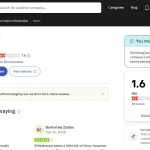
Rizzio’s current Trustpilot profile shows a 1.6/5 TrustScore from 27 reviews. The visible distribution is heavily concentrated at one star, with 96% of the reviews shown as one-star reviews and 4% as four-star reviews at the current crawl. That is a clearly negative sentiment signal.
The content of those reviews also shows repeated themes. Reviewers allege delayed or refused withdrawals, removal of winnings, difficult verification and disputes about bonus or account terms. Some reviewers identify themselves as being in Great Britain, while others are from different countries. These are claims made by individual users, not findings made by Trustpilot or a regulator.
There is another reason not to reduce the whole profile to a simple average. At least one visible review on the profile refers to a TikTok shop with a similar name rather than the casino. That kind of profile contamination can distort the usefulness of a small review sample. The low TrustScore still matters, but the sensible reading is “negative user sentiment with a limited and imperfect dataset,” not “27 independently verified casino failures.”
AskGamblers adds complaint outcomes, not just ratings
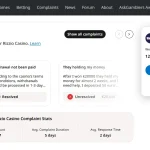
AskGamblers currently lists four complaints for Rizzio Casino. Two are marked resolved and two unresolved. Its current complaint statistics also show an average complaint duration of about five days and an average response time of about two days for the cases in its dataset.
The resolved cases are important because they prevent a one-sided reading of the record. One complaint describes a delayed withdrawal alongside repeated document requests and is marked resolved. Another describes a withdrawal that the user said had not arrived after the casino reported payment; that case is also marked resolved. A separate complaint involving a larger disputed amount remains unresolved, and another complaint is unresolved as well.
The resolution label is useful, but it should be interpreted narrowly. “Resolved” tells you that the complaint process reached a resolved status on AskGamblers. It does not automatically mean that every allegation was proven, that the operator admitted wrongdoing, or that the outcome would satisfy every reader. Likewise, “unresolved” does not by itself prove misconduct. It tells you the dispute was not recorded as resolved by that complaint service.
For someone deciding whether to deposit, the strongest signal is not a dramatic sentence from one complaint. It is the pattern: multiple cases involve withdrawals, verification or disputed balances, and half of the currently listed cases remain unresolved.
The recurring withdrawal theme deserves attention
Across the current reputation sources, withdrawal friction appears repeatedly. Users describe cashout requests that remain pending, repeated verification checks, cancelled withdrawals and disputed removals of balances. These are allegations or complaint narratives, not verified statements that Rizzio treats every withdrawal this way.
The practical value of the pattern is different. When several independent users complain about the same stage of the customer journey, that stage deserves more scrutiny before money is committed. A prospective player should understand the withdrawal rules before depositing, avoid assuming that account verification is a one-step process and keep evidence of completed checks and payment requests.
The guide to withdrawal mechanics and KYC deals with cashout process details. This reputation page is narrower: it asks whether public complaint records give you a reason to treat withdrawal reliability as an important decision factor. On the current evidence, they do.
Verification complaints are not proof that KYC itself is improper
Several public complaints connect withdrawal delays with identity verification or requests for additional documents. That can sound alarming, but the complaint theme should not be confused with a claim that verification itself is illegitimate. Online gambling operators commonly use identity and payment verification, and Rizzio’s own process can include KYC before or during withdrawals.
The question raised by the complaints is about execution: whether requests are clear, proportionate, consistent and handled without avoidable delay. A user who says the same document was requested repeatedly is making an allegation about process quality. Unless a complaint service independently establishes the facts, that remains the user’s account.
This distinction keeps the assessment evidence-based. Saying “there are complaints about repeated verification” is supported by the public record. Saying “Rizzio deliberately uses KYC to avoid paying players” would go beyond what these sources establish. The first is evidence-based risk context; the second would turn allegations into an objective accusation.
Bonus and balance disputes need the same evidential discipline
Some current reviews and complaints allege that winnings were removed after the operator applied bonus, device, account or terms-related rules. Those accounts are serious from the user’s perspective, but they still need to be described as allegations unless a complaint outcome or other primary evidence establishes more.
This is also why bonus terms should be read before a first deposit rather than only after a win. If a promotion is active, keep a copy of the applicable terms, note wagering conditions, and avoid assuming that completing a visible progress meter settles every eligibility rule. If no bonus is intended, make that choice explicit where the product allows it and retain the transaction record.
The current complaint record does not support a sweeping claim that Rizzio confiscates winnings as a general practice. It does support a narrower conclusion: disputes involving balances and terms appear often enough in third-party records that a player should preserve evidence and understand the conditions before playing.
Casino Guru’s 1.4/10 Safety Index uses a separate methodology
Casino Guru currently rates Rizzio at 1.4/10 and classifies its Safety Index as Very low. Casino Guru says its index considers factors such as terms and conditions, complaints, casino size, blacklists and other information gathered through its review process.
That rating is relevant because it is not simply a star average from users. It is a proprietary risk score produced under Casino Guru’s methodology. The site currently says it found issues in Rizzio’s terms and describes the complaint ratio as very bad relative to the casino’s estimated size.
The limitation is equally important: Casino Guru is not a gambling regulator. Its Safety Index does not have the legal status of a licence decision, enforcement action or court finding. Ratings can also change as the site updates complaints, terms and other inputs.
For UK readers, keep this reputation score separate from the licence and regulatory context. The licence page deals with the operator’s actual regulatory position. The Safety Index is a third-party assessment of risk and fairness.
Resolved complaints matter because cherry-picking gives a false picture
A reputation review can become misleading if it lists only the worst allegations. Rizzio’s current AskGamblers record includes resolved cases, and those outcomes belong in the evidence alongside unresolved disputes.
Resolution can mean that a payment arrived, communication improved, documents were accepted or another settlement was reached. Without overstating details that are not independently verified, the existence of resolved cases shows that the complaint record is not uniformly one-directional.
At the same time, a 2-of-4 resolution split is not strong evidence that complaint handling is consistently effective. It is a small dataset in which half the cases are unresolved. That is enough to justify caution, but not enough to calculate a reliable probability that any future complaint will succeed or fail.
Small samples are especially vulnerable to rapid change. One new complaint or resolution can shift the proportions materially. The current figures are therefore time-sensitive rather than permanent characteristics of the brand.
What UK players can verify before depositing
- Check the current review counts, not just the score. A rating based on a few dozen reviews should be read differently from one based on thousands.
- Open the complaint cases. Look at whether they are resolved, unresolved, rejected or still open, and note the dates.
- Separate allegations from outcomes. A user’s account is evidence of dissatisfaction, not automatic proof that every disputed fact is correct.
- Read withdrawal and verification rules first. Know what documents may be requested and what restrictions could affect a cashout.
- Save relevant terms and transaction records. Records of deposit choices, bonus status, verification approval and withdrawal requests can make a later dispute easier to document.
- Recheck the operator’s regulatory position. Reputation data is not a substitute for licence verification or local consumer-protection analysis.
How much weight should you give one dramatic review?
Very little on its own. The strongest review-based evidence comes from repetition across sources, consistency over time and complaint outcomes that can be independently followed. A single one-star post can be mistaken, incomplete or emotionally written. A single positive review can be unrepresentative too.
For Rizzio, the useful signal is the combination of a very low Trustpilot score, multiple AskGamblers complaints with mixed outcomes and a very low Casino Guru Safety Index. The overlap around withdrawals, verification and disputed balances makes those topics more decision-relevant than any isolated insult or accusation in a review.
That still falls short of proving fraud, non-payment as a universal practice or any other criminal or categorical claim. Those labels require much stronger evidence than review platforms provide.
Use complaint records as a risk filter, not a verdict
Reputation sources are most useful when they change what you verify before spending money. A weak reputation record should lead to a lower tolerance for ambiguity: clarify bonus status, complete available verification early, keep deposits proportionate, and confirm how withdrawals are requested and tracked.
The record should not be treated as certainty. Nobody can infer from current public complaints that a particular future withdrawal will be delayed, paid quickly, disputed or cancelled. Complaint platforms are backward-looking records of individual experiences, and ratings compress different experiences into numbers.
If you want the wider product picture before making that decision, the full Rizzio UK review puts these reputation signals alongside games, payments, mobile access, bonuses and regulatory context.
How much weight UK players should give Rizzio’s complaint record
Rizzio’s current reputation record deserves substantial weight because three third-party sources point to elevated concern: Trustpilot shows 1.6/5 from 27 reviews, AskGamblers records four complaints split between two resolved and two unresolved, and Casino Guru assigns a 1.4/10 Safety Index labelled Very low.
Used comparatively, that evidence supports treating withdrawals, verification and disputed balances as areas that deserve careful pre-deposit checking. It does not support turning every reviewer allegation into a proven fact, calling Rizzio a scam as an objective conclusion, or assuming every player will encounter the same problems.
For a UK reader, the useful takeaway is to combine the reputation evidence with the separate regulatory picture, keep documentation and avoid risking more money than you are comfortable having tied up in a disputed process. The complaint record cannot predict an individual outcome, but it is weak enough that ignoring it would remove relevant information from the decision.
Rizzio Casino Games and Software Providers

Rizzio Casino Games and Software Providers
Rizzio Casino UK Guide Section elementRizzio offers a broad casino lobby built around slots and...
Is Rizzio Casino Safe for UK Players? Licence and Regulatory Review
Rizzio Casino UK Guide Section elementRizzio Casino is operated by Green Champions Leader S.R.L. under...

Rizzio Casino Payment Methods in the UK: GBP Deposits and Banking
Rizzio Casino UK Guide Section elementRizzio supports British pounds and its verified banking mix includes...

Rizzio Casino Mobile Review: Browser Play, iPhone and Android
Rizzio Casino UK Guide Section elementRizzio supports play through mobile browsers, so a UK user...

Rizzio Casino Bonuses for UK Players: Offers, Wagering and Eligibility
Rizzio Casino UK Guide Section elementRizzio has current bonus listings at brand level, but a...

How to Register at Rizzio Casino: UK Sign-Up and KYC Guide
Rizzio Casino UK Guide Section elementRizzio account opening should be viewed together with KYC, not...